
Fluid Relational Design - Designing for Biophilia Blog #17
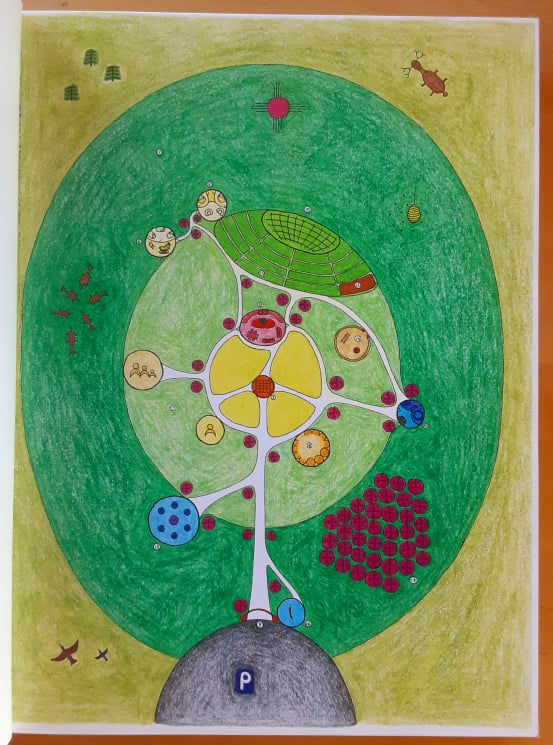
About the time I finally realized that I needed to separate functions in my drawings, I was working at adapting the rough pattern pictures from A Pattern Language. These pictures expressed their associated patterns in various ways. Sometimes the drawings showed a plan view, other times an elevation or a cross section. Gradually, I realized that I was developing enough plan view drawings to begin to put them together. The larger patterns began to contain the smaller ones. Eventually, an entire site plan emerged that contained all but the largest and smallest patterns that we had chosen.
Using Christopher Alexander’s directions as presented above, I kept working gradually to make the site plan whole, I worked at each part until I liked it (this often meant redrawing a line or curve many times until it felt just right), I introduced color and applied it in its various shades, and I did this over and over again. Alexander believes that we can gradually improve our chosen patterns by testing them against experience. He says that by recognizing how certain patterns make us feel, we can determine, very simply, whether these patterns make our surroundings live or not. Again, I was still limited to drawing paper at this point. Yet I applied these principles as best as I could to my situation. Again, I am leaving it up to you, discerning reader, to determine to what extent I have achieved living structure on this site plan.
This site plan is fluid in that no dimensions are firmly established. Some sizes are suggested by the placement of beds, tables, sinks, and other furniture and appliances, but any element can be easily adjusted to the particularities of a specific site. Circles and curves dominate the design, shapes that lend themselves to flexibility, as opposed to squares and straight lines, which tend to imply rigidity. The patterns are numbered and correspond to an accompanying key for easy identification. A total of sixteen pattern elements are shown from the largest, homestead, to the most peripheral, farm store. One pattern of particular importance is main entrance. The entrance is to impart on visitors a feeling that they are leaving mundane conventional existence behind and entering a transcendent magical realm. A series of entrances can make this transition more effective while a circular passage may convey a rebirthing process.
This relational site design also includes many fanciful elements such as a beehive
with bees, grazing ruminants, soaring eagles, as well as the Zia sun symbol. It was fun to draw and became the focal point of my presentation to colleagues at the Core Leadership Seminar. As I had been exploring in my research, the goal was to capture the imagination. Without requesting a formal survey, I cannot report the results with certainty. However, the impression it created seemed to be very positive. The colorful design obviously caught students’ attention. The general comments on the Oral Presentation Feedback Forms ranged from beautiful to fun to idealist for this presentation as a whole. When specifically mentioned, the site design was referred to as beautiful and awesome. Still, it is difficult to measure how deep or shallow these impressions were. Some students expressed a desire to arrange patterns somewhat differently. This must be considered a success, for the goal is not to win support for ‘my design’, but to motivate others into designing for themselves. The final site drawing was done on very large, presentation size, 24 by 36 inch paper. It is fully colored and shaded with pattern elements numbered. Each student received a corresponding written key as well as my verbal descriptions. Later this final drawing was mechanically reduced to a black & white copy on 8+1/2 by 11 inch letter size paper. I then reintroduced the colors by hand for presentation in this document.


Comments