
Designing for Biophilia Thesis - Blog post #21
Matysiak Pattern Language Part 1 of 4
Selected Patterns from:
A Pattern Language, as originally developed by Christopher Alexander, Sara Ishikawa, Murray Silverstein
Autonomous Regions – P1
Metropolitan regions will not come to balance until each one is small and autonomous enough to be an independent sphere of culture.
Whenever possible, work toward the evolution of independent regions in the world; each with a population between 2 and 10 million; each with its own natural and geographic boundaries ; each with its own economy; each one autonomous and self-governing; each with a seat in a world government, without the intervening power of larger states and countries.

Agricultural Valleys – P2
The land which is best for agriculture happens to be best for building too, but it is limited, and once destroyed, it cannot be regained for centuries.
Preserve all agricultural valleys as farmland and protect this land from development which would destroy or lock up the unique fertility of the soil. Even when valleys are not cultivated now, protect them, keep them for farms and parks and wilds.

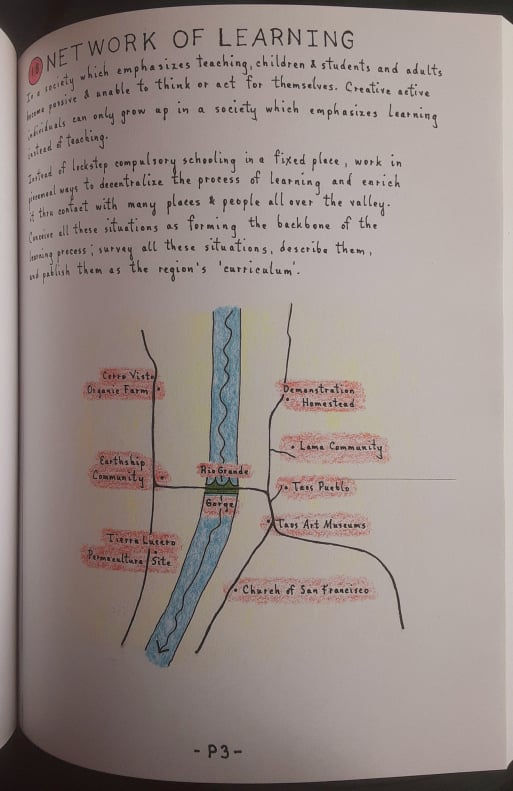
Network of Learning – P3
In a society which emphasizes teaching, children and students – and adults – become passive and unable to think or act for themselves. Creative, active individuals can only grow up in a society which emphasizes learning instead of teaching.
Instead of lock step of compulsory schooling in a fixed place, work in piecemeal ways to concentrate the process of learning and enrich it through contact with many places and people if near the city: workshops, teachers at home or walking through the city, professionals willing to take on the young as helpers, older children teaching younger children, museums, youth groups traveling, scholarly seminars, industrial workshops, old people, and so on. Conceive of all these situations as forming the backbone of the learning process; survey all these situations, describe them, and publish them as the city’s “curriculum”; then let students, children, their families and neighborhoods, weave together for themselves the situations that comprise their “schools”, paying as they go with standard vouchers, raised by community tax. Build new additional facilities in a way which extends and enriches this network.
Common Land – P4
Without common land no social system can survive.
Have over 25% of the land in house clusters to common land which touches, or is very near, the homes which share it. Basis: be wary of the automobile, on no account let it dominate the land.
People will not feel comfortable in their houses unless a group of houses forms a cluster, with the public land between them jointly owned by all the householders.
Arrange houses to form rough, but identifiable clusters of 4 – 8 shelters around some common land and paths. Arrange the clusters in that anyone can walk through them, without feeling like a trespasser.


Comments